
x
African Health Sciences
[contact-form-7 id="2459" title="Sidebar Form"]

  • 256(41)530021
  • info@africanhealthsciences.org
African Health Sciences
  • info@africanhealthsciences.org
  • Give Feedback
  • Home
  • About Us
  • Staff
  • Focus & Scope
  • For Authors
  • More Links
    • About The Journal
    • Latest Articles
    • Journal Archives
    • Our Events
    • Faq’s
  • Contact Us
Logo

Contact Info

  • P. O. Box 7072 Kampala, Uganda
  • +256(41)530021
  • info@africanhealthsciences.org
  • ISSN 1680-6905
  • <!--
  • -->

12Sep2017

Healthcare spending and health outcomes: evidence from selected East African countries

by admin,  0 Comments
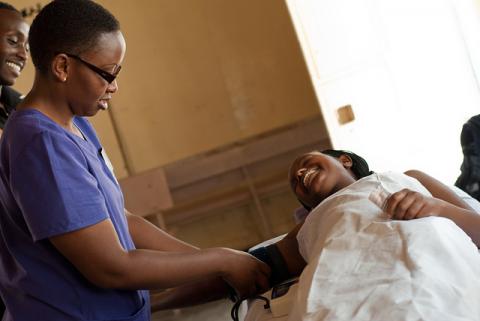
Healthcare spending and health outcomes: evidence from selected East African countries.

Murad A.Bein1, Dogan Unlucan, Gbolahan Olowu, Wagdi Kalifa
1. Faculty of Economics and Administrative Sciences, Cyprus International University, Lefkosa, Turkey
2. Faculty of Business and Economics, Eastern Mediterranean University Famagusta, Turkey

Abstract
Background: Over the last decade, total healthcare expenditures, comprised of both public and private healthcare expenditures, have increased in most East African countries. At the same time, health outcomes such as infant mortality rates, life expectancy at birth and other health outcome indicators have improved.

Objectives: This paper examines the association between healthcare expenditures and health outcomes for eight East African countries: Burundi, Eritrea, Ethiopia, Kenya, Rwanda, Sudan, Tanzania, and Uganda. In this study, health outcomes are defined as an improvement in adult life expectancy and a reduction in the number of neonatal, infant, and under-five deaths.

Methods: We implemented a panel data regression technique, analyzing both cross-sectional and time series information. This combined method has been used in healthcare studies by several authors. Data obtained from world development indicators for the years 2000-2014 was used for the panel study.

Results: First, we documented that there is a strong, positive association between total healthcare expenditures and total life expectancy. While we identified a positive relationship between healthcare expenditures and female and male life expectancy, we found that healthcare had a stronger effect on improving life expectancy in females than in males. Moreover, we found a negative relationship between healthcare expenditures and the number of neonatal, infant, and under-five deaths.

Conclusion: The results of this study have important policy and management implications for the eight East African countries. From a policy perspective, it is necessary to understand if a greater allocation of resources to the healthcare sector is worthwhile and to determine whether to encourage private healthcare investment. From the management perspective, investing in more private institutions, such as hospitals and clinics, is essential for health outcomes in the average country. The results of this study can be used by the World Health Organization as well as other non-governmental organizations that provide financial assistance to East African countries.

Keywords: Healthcare expenditures, health outcome, life expectancy, infant deaths, under-five deaths, neonatal deaths.

Related posts:

Biochemical markers of mineral bone disorder in South African patients on maintenance haemodialysis...

Assessing regional variations

cause of death in a forensic autopsy

Recent Posts

  • Editor’s choice: Tackling infectious diseases, NCDs and sexual reproductivehealth issues as we enter our 24th year of remarkable growth
  • Preconception and contraceptive care for women living with HIV/AIDSattending antiretroviral treatment clinics in Lagos State, Nigeria
  • Effects of SNPs on TNF-α and IL-10 cytokine expression in TB and HIVpatients in the Capricorn district, Limpopo Province, South Africa
  • Prevalence of Schistosomiasis in a neglected community, South western Nigeria at two points in time, spaced three years apart
  • Review of Leishmaniasis in the Middle East and North Africa

Recent Comments

No comments to show.

Archives

  • April 2024
  • May 2019
  • April 2019
  • September 2018
  • August 2018
  • January 2018
  • December 2017
  • November 2017
  • October 2017
  • September 2017

Categories

  • 2001 Issues
  • 2002 Issues
  • 2003 Issues
  • 2004 Issues
  • 2005 Issues
  • 2006 Issues
  • 2007 Issues
  • 2008 Issues
  • 2009 Issues
  • 2010 Issues
  • 2011 Issues
  • 2012 Issues
  • 2013 Issues
  • 2014 Issues
  • 2015 Issues
  • 2016 Issues
  • 2017 Issues
  • 2018 Issues
  • 2019 Issues
  • 2024 Issues
  • Articles
  • December issue
  • December Release
  • June Issue
  • June Release
  • March Issue
  • March Issue
  • March Release
  • News
  • number / volume 2
  • number /volume 1
  • number /volume 1
  • number /volume 1 2008
  • number 1
  • number 1
  • number 1
  • number 1
  • number 1
  • number 1
  • number 1
  • number 2
  • number 2
  • number 2
  • number 2
  • number 2
  • number 2
  • number 2
  • number 2 special Issue
  • number 2 special Issue 2
  • number 3
  • number 3
  • number 3
  • number 3
  • number 3
  • number 3
  • number 3
  • number 4
  • number 4
  • number 4
  • number 4
  • number 4
  • number 4
  • number/ volume 3 2008
  • number/ volume 4 2008
  • number/volume 1
  • number/volume 1
  • number/volume 2
  • number/volume 2
  • number/volume 2 2008
  • number/volume 3
  • number/volume 3
  • number/volume 3
  • number/volume 4
  • number/volume1
  • September Issue
  • September Release
  • Special Edition
  • special Issue
  • Uncategorized
  • Vol. 24 No. 1 (2024)
  • volume 1
  • volume 1
  • volume 1
  • volume 2
  • volume 2
  • volume 2
  • volume 2
  • volume 2
  • volume 3
  • volume 3
  • volume 3
  • volume 3
  • volume 4
  • volume 4
  • volume 4
  • volume 4
  • volume1

Categories

  • 2001 Issues
  • 2002 Issues
  • 2003 Issues
  • 2004 Issues
  • 2005 Issues
  • 2006 Issues
  • 2007 Issues
  • 2008 Issues
  • 2009 Issues
  • 2010 Issues
  • 2011 Issues
  • 2012 Issues
  • 2013 Issues
  • 2014 Issues
  • 2015 Issues
  • 2016 Issues
  • 2017 Issues
  • 2018 Issues
  • 2019 Issues
  • 2024 Issues
  • Articles
  • December issue
  • December Release
  • June Issue
  • June Release
  • March Issue
  • March Issue
  • March Release
  • News
  • number / volume 2
  • number /volume 1
  • number /volume 1
  • number /volume 1 2008
  • number 1
  • number 1
  • number 1
  • number 1
  • number 1
  • number 1
  • number 1
  • number 2
  • number 2
  • number 2
  • number 2
  • number 2
  • number 2
  • number 2
  • number 2 special Issue
  • number 2 special Issue 2
  • number 3
  • number 3
  • number 3
  • number 3
  • number 3
  • number 3
  • number 3
  • number 4
  • number 4
  • number 4
  • number 4
  • number 4
  • number 4
  • number/ volume 3 2008
  • number/ volume 4 2008
  • number/volume 1
  • number/volume 1
  • number/volume 2
  • number/volume 2
  • number/volume 2 2008
  • number/volume 3
  • number/volume 3
  • number/volume 3
  • number/volume 4
  • number/volume1
  • September Issue
  • September Release
  • Special Edition
  • special Issue
  • Uncategorized
  • Vol. 24 No. 1 (2024)
  • volume 1
  • volume 1
  • volume 1
  • volume 2
  • volume 2
  • volume 2
  • volume 2
  • volume 2
  • volume 3
  • volume 3
  • volume 3
  • volume 3
  • volume 4
  • volume 4
  • volume 4
  • volume 4
  • volume1

Archives

  • April 2024
  • May 2019
  • April 2019
  • September 2018
  • August 2018
  • January 2018
  • December 2017
  • November 2017
  • October 2017
  • September 2017

Tags

Achives Latest News


ISSN 1680-6905

  • P. O. Box 7072 ,Kampala, Uganda
  • Call Us: 256(41)530021
  • info@africanhealthsciences.org

Latest Activities

Usefull Link

  • About AHS
  • Services
  • Focus & Scope
  • Our Articles
  • Contact Us

Subscribe

For research updates from African Health Sciences, sign up now!

[contact-form-7 id="1620" title="Subscribe"]

African Health Sciences © All Right Reserved